


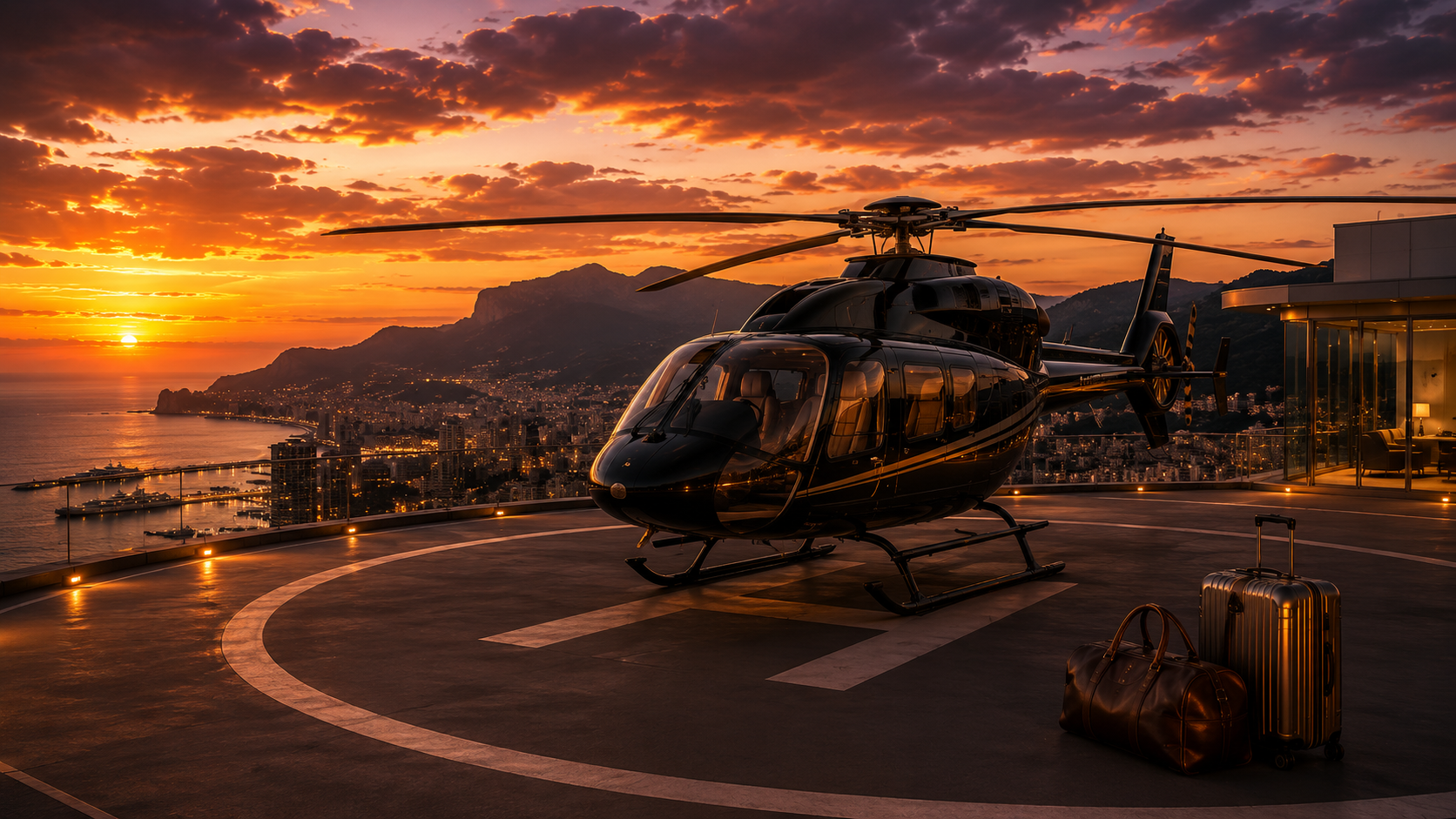
A helicopter versus car decision is a routing decision, not a status decision. The useful comparison looks at the complete door-to-door journey: terrain, actual road access, weather exposure, usable landing sites, luggage, and the consequence of missing the next connection. Belka Travel Concierge can coordinate the information needed to compare the options sensibly.
Compare the full journey, not the map distance
A short aerial distance may conceal a straightforward drive—or a road involving mountain bends, water crossings, seasonal constraints, or urban congestion. A helicopter journey also has road segments: passengers must reach the departure site and travel from the arrival site to the final address.
Provide exact addresses rather than city names, the preferred departure window, and how critical the arrival time is. Where an airline connection is involved, terminal logistics deserve their own plan; see the options for airport coordination. If both endpoints are readily accessible by road, a ground transfer can be the cleaner end-to-end solution.
Terrain and access determine the real advantage
A helicopter may be worth assessing when road travel is disproportionately difficult: remote resorts, mountainous areas, water-separated locations, or itineraries that would otherwise require several changes. That said, the destination needs a confirmed operational landing solution. City centres, protected areas, private land, and smaller properties can all have access limitations.
A vehicle is often stronger when the itinerary includes several stops, substantial luggage, child seats, or flexibility to adjust en route. Ask about the final approach road, seasonal access, and the precise handover point. The helicopter transfer page illustrates the kind of journey that can be evaluated, but each route still needs a specific review.
Build around weather uncertainty
Helicopter operations depend on actual visibility, wind, conditions at the sites, and operational restrictions. A favourable forecast does not guarantee that a flight can proceed at the desired moment. Do not make a non-recoverable connection depend on one air option alone.
A sound plan identifies a ground alternative, a decision point for switching to it, and a buffer before a flight, cruise, event, or meeting. Explain whether punctual arrival, privacy, fewer changes, or taking all luggage matters most. For complex itineraries, the principles in this article on a multi-city business roadshow are useful: critical links need a fallback designed in advance.
Landing sites are a separate workstream
“Near the hotel” is not enough. Departure and arrival locations, passenger access, onward transport, and operating conditions must all be checked. A private site may need owner approval; a public site may have its own access rules or operating limitations. An open patch of land should never be assumed suitable for a landing.
Share the addresses, date, passenger count, receiving contact, and any flexibility in timing. For airport journeys, separate the air movement from the terminal process: bags, check-in requirements, and access through the terminal are not automatically solved by the transfer.
Luggage can change the answer
Helicopters have limits on weight, dimensions, and stowage. Hard cases, skis, instruments, pushchairs, mobility equipment, and unusual sports gear should be declared early. Give approximate weight and dimensions for each item rather than a general estimate. The group composition can matter too.
If there is a lot to carry, practical options include a car for luggage, a separate ground delivery, or an entirely road-based journey. The checklist in private aviation baggage planning is a helpful way to describe unusual items. Convenience after landing also matters: one simple vehicle transfer with the bags may beat several fragmented moves.
Protect the onward connection
For an airport or charter connection, count every stage: arrival at the correct point, bag handover, terminal procedures, and a margin for disruption. The harder a missed connection is to recover, the more valuable a conservative plan becomes. A helicopter can be the preferred option while a vehicle is kept ready as a genuine fallback.
For a flexible leisure journey, road transport may win on simplicity. For difficult terrain, a narrow arrival window, or a remote endpoint, a helicopter can remove tiring stages if landing arrangements and Plan B are credible.
Information to send before choosing
- door-to-door addresses, date, and preferred time window;
- passenger count, children, and mobility or other needs;
- number, estimated weight, and dimensions of all bags;
- what follows on arrival and the consequence of delay;
- stops, airport meet-and-assist, or separate luggage delivery required.
Read further practical guidance in the Belka Travel Concierge articles, then send the outline through the contact page. A coordinator can help compare the route and identify where a reserve arrangement is prudent.